Chapter I · Inner Life
When Experience Sounds Like an Opinion
I had four litres of engine oil in my car. I needed one litre, which left about three litres in the container. The problem was that afterwards I could no longer close it properly.
Listen to this essay6 min
AI-generated narration

I had made a similar mistake before. I knew how easily oil could find its own way out, even when a container seemed reasonably secure. Once it escaped, it could spread into places that were difficult to reach. I did not want to spend my time trying to get it out of my car again.
So I decided to take the container out.
There was still useful oil inside. I knew that. But I also knew that the container was no longer something I trusted.
The same container, a different conclusion
Someone else saw it differently. They said that keeping the oil would not be a problem, and that it was a shame to leave something that might be needed later.
I could understand that. Three litres of oil have value. From that point of view, I was giving up something useful because of a problem that appeared to have a simple solution.
The person put plastic film over the opening and secured it with a rubber band. Then they took the container into their own car.
We were looking at the same thing. The same oil, the same opening, the same container that would not close properly. Yet we were making different decisions.
One of us was thinking about what could be saved. I was remembering what I might have to clean.
I cannot know exactly how certain the other person felt. Perhaps the plastic film seemed strong enough. Perhaps keeping the container upright seemed sufficient. What I know is that the arrangement was acceptable to them. It was not acceptable to me.
That difference stayed with me even before I knew what would happen.
What the oil left behind
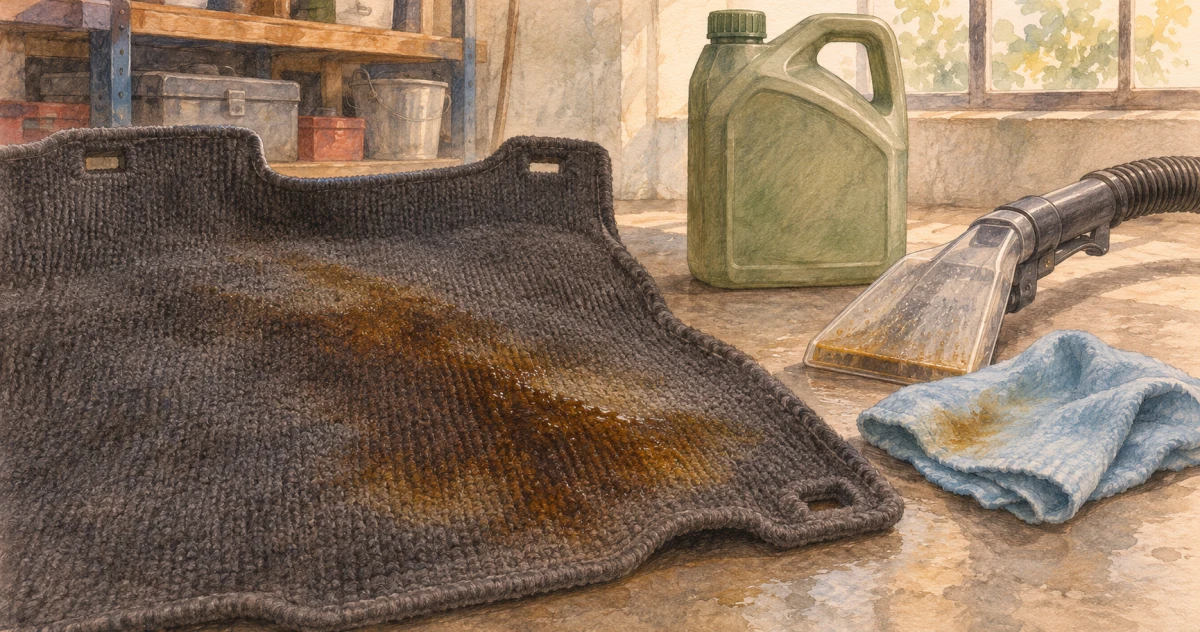
A few days later, the oil had leaked into the other person’s car. The plastic film and rubber band had not kept it contained.
The interior needed a thorough professional cleaning to deal with the oil. Something that had seemed worth keeping had become a much larger problem.
I do not tell this because I enjoyed being right. I would much rather the oil had stayed inside and nobody had needed to clean a car because of it.
But I did think about the moment when I had decided to remove it from mine. I had already considered whether the oil might be useful later. That was not a possibility I had forgotten. I had simply given more weight to what could happen if the container leaked.
Sometimes a decision looks wasteful until we see what it was trying to prevent.
When a lesson sounds like a concern
I have been thinking about how easily experience can sound like an opinion.
When I said that I did not want to keep the oil in my car, the other person could hear a concern about something that might happen. For me, it was connected to something that had already happened.
I could not prove that this container would leak on this occasion. Perhaps it would remain upright. Perhaps the improvised cover would hold. There was a possibility that nothing would go wrong.
I knew that possibility existed. I also remembered enough about the other possibility to decide that I did not want to take the risk again.
That is a different starting point from simply not having thought of a solution.
When someone tells us why they do not want to do something, it is easy to begin looking for a way around their concern. We may be trying to help. We may genuinely believe that we have found an answer they have overlooked.
But have we understood how they reached their decision? Have we asked what they are remembering?
I return to that question in Listening Without Preparing Your Reply. It takes effort to hear a person’s reasoning while our own answer is already forming. Sometimes we begin solving the problem before we understand what the problem means to them.
What we bring to an ordinary decision
We carry experiences that other people cannot see. They can sit behind a small hesitation, a practical preference, or a decision that looks unnecessarily cautious from the outside.
Someone sees a container. Someone else remembers the work of cleaning up after one. We do not always explain that whole history when we say, “I would rather not.”
Of course, experience does not make every conclusion correct. I can learn too much from one bad outcome. I can become cautious in a situation where another person’s suggestion really would work. I want to remain open to being shown a better way.
That openness matters on both sides. I need to listen to a new suggestion, and the person offering it needs to listen to the experience behind my hesitation.
I think of our wish to understand other people here. Understanding is difficult when we assume that what we can see is everything they have considered.
Perhaps someone has already tried what we are suggesting. Perhaps they have spent hours dealing with a consequence that we have only imagined. Or perhaps their earlier experience is leading them towards a conclusion that deserves to be reconsidered.
We cannot find that out by treating their decision as a mistake before we have heard the reasoning behind it.
A question would give us more to work with: what happened the last time?
I would rather nobody needed the lesson
I do not believe the person wanted oil all over their car. They wanted to keep something useful. I understand that wish. The cover they improvised simply did not prevent what I had been trying to avoid.
The next time someone hesitates over something I think is simple, I hope I will ask what brought them to that hesitation. There may be a practical lesson there that I do not need to learn in the same way.
I knew there were three litres left. I knew the oil might be needed later. I also remembered what it was like when oil found its own way out.
That memory was part of the decision, even if nobody else could see it.